US Stocks
 US Options
 ETFs
ETFs Emerging Asia
 GBP Cash Savings
 Charts & Tools
 Paper Trading
 Extended Hours
 Wall Street Journal
 TradingView
Swing Trading

What is swing trading?
Swing trading is a short-term trading style that aims to make relatively small profits from market swings that last from a day to several weeks.
Unlike day trading, which requires investors to watch the market closely all day to spot potential entry and exit points, swing trading requires less time and energy.
Compared with long-term investing that may aim to obtain a return of more than 20%, a swing trade usually sets a 5%-10% profit target. As small as the profits can be, investors could still get a considerable annual return rate if losses are kept to acceptable levels.
Which types of securities may offer more opportunities for swing trading?
As swing traders aim to make profits from short-term price swings, they usually select candidates from the most actively traded stocks/ETFs that tend to swing within broad, well-defined ranges.
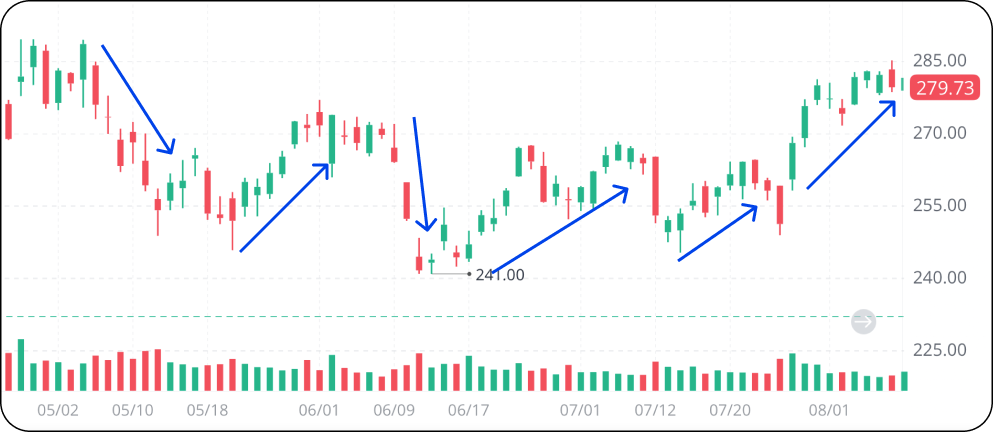
Let’s look at an example of a popular large-cap stock to see how swing traders would take advantage of its price swings.
In the graph below, we can see that the stock swings within a range of $241-$290 from May to August. There are at least six upward and downward movements that swing trades can exploit, each potentially allowing a 5% or more profit.
What are some swing trading strategies?
There are a variety of strategies that investors may use in swing trading. Most of them involve technical analysis.
Unlike day traders who may like to look for trading opportunities on a 5-minute or 15-minute chart, swing traders usually prefer to use a 4-hour or daily time frame on their charts.
Swing traders may:
- Identify price reversal signals: They may look for candlestick/chart patterns, MA crossovers, MACD crossover, etc. to identify price reversal signals. When reversal signals are identified, they establish an open/short position to trade the upcoming trend.
- Trade an existing trend: They may enter a trade when a trend has just formed and exit the trade before the trend ends by using support and resistance.
We’ll cover more content about swing trading strategies in the coming lessons.
What are some risks associated with swing trading?
Swing trading requires investors to time the market—trade a trend before it ends or starts. However, the stock market is more likely to behave randomly over the short term. If the investors are wrong about where the market is heading, they could suffer great losses. Stop-loss techniques can help, but you can still lose all or more than your initial investment.
The Bottom Line
Swing trading can be profitable by trading short-term market swings that last for a day to several weeks. However, the market tends to behave more randomly over the short term. Investors should be aware of the risks before they start swing trading.
Not sure if swing trading is the right trading style for you? Try it in paper trading before applying it in a live account!